
Homochirality behind Nobel Chemistry win
Submitted by:
Andrew Warmington
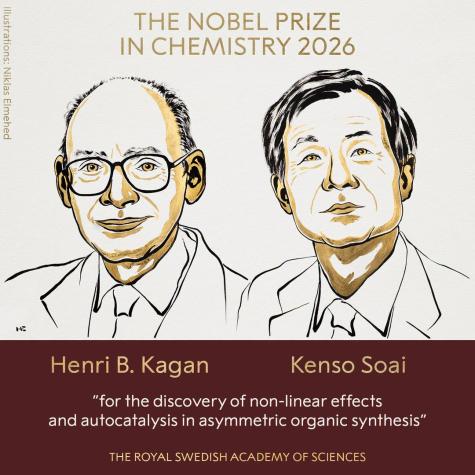
Henri Kagan of Université Paris-Sud and Kenso Soai of Tokyo University of Science have won the Nobel Prize in Chemistry 2026 “for the discovery of non-linear effects and autocatalysis in asymmetric organic synthesis”. This recognises discoveries that enabled chemists to drive chemical reactions that lead to homochirality.
Living organisms are homochiral: they only contain one of the ‘mirror images’ found in many natural molecules. How this chemical asymmetry emerged was unknown and chemists struggled to produce homochiral molecules that would interact with living beings in desired ways, most notably in pharmaceuticals
In 1968, Kagan discovered a way of manipulating chemical reactions to create a greater excess than had previously been thought possible of one of the two ‘mirror images’. Soai published the first potentially homochiral chemical reaction in 1995 and succeeded in presenting it eight years later.
“Henri Kagan and Kenso Soai have provided a solution to a chemical mystery that is over a century old: how homochirality can emerge spontaneously. The chemical reactions they have developed are spectacular,” said Heiner Linke, chair of the Nobel Committee for Chemistry.