
Feature article - Can AI think like the commercial team too?
Submitted by:
Andrew Warmington
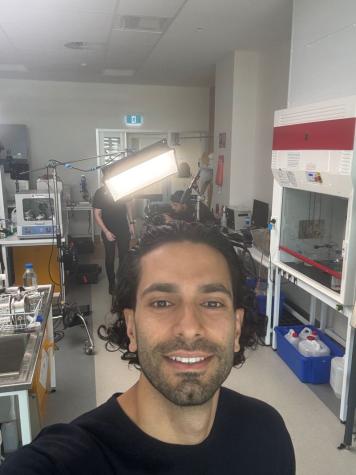
Dr Farid Mirmohseni, CEO of Kimia, argues the chemical industry's AI investment has skipped the commercial and technical sales function
Over the past few years, AI has transformed the lab and plant floor. R&D has purpose-built tools for formulation and discovery, while plant operators use AI to optimise processes and equipment performance.
Having data accessible and available made these functions an obvious place to start. Commercial teams have had no such luck — least of all technical sales, the specialists who field customer questions that require deep expertise.
Chemical expertise has always been rationed. On average, one technical expert has about 20 conversations per month. A commercial team may need that expertise for thousands of customers, all with different constraints and requirements.
For example, a cosmetics formulator asks whether a replacement preservative or emulsifier holds up under a revised EU Cosmetics Regulation annex, at the same use level and in the same pH range. Today, the answer requires a PIM, a CRM, a regulatory database and an email chain to a technical expert. At a time when profit margins are tight, responding to customers can take weeks.
Increased reformulation pressure and supply volatility mean commercial teams are answering more technical questions in real time. The knowledge to respond exists, but it is fragmented and locked in the heads of a small number of people who have built it over decades. The ability to scale expertise is what is capping profitable growth.
Deployment is not judgement
McKinsey found chemical companies that rewired the operating model to allow for digital tools and AI deployment can achieve 10–20% above market growth.1 The industry is facing increased pressure to deploy AI at pace and own the software adopted across the organisation. For commercial leaders and CMOs, the temptation is to layer generative AI onto systems already in place.
So, a company launches a pilot: a chatbot for commercial teams to answer questions like whether a product will perform under constant humidity. Either it fails outright, or it succeeds with a small group of users and then fails once it is rolled out at scale. Very few go all in and launch from Day One.
When it does work, the chatbot’s response sounds smart, clean and complete. However, technical sales requires producing answers that can be trusted. Will the recommendation still hold if the humidity specifications shift or a regulation is updated? A generic AI tool can find the right document; it cannot discern which facts are binding, which source to trust when they conflict or whether the evidence is strong enough to support a recommendation at all.
That is because a technical answer is not one single data point. It involves multiple domains including chemistry, application, regulation, supply chain and customer constraints. Change any one of the variables and the answer changes too, often only becoming clear after the chatbot has provided its ‘clean’ response.
Considerations for successful AI adoption
Instead of opting for the ‘smartest’ model, consider how it will actually operate within the organisation. It can be helpful to break this down into three layers:
- Data: What systems can the platform access and where should it be constrained? For example, knowing whether the platform can see the SDS library and regulatory databases.
- Platform: How are access permissions, source ranking, validation and uncertainty handling managed?
- Application: Can the platform take real action and surface the right information or an approved alternative?
When evaluating AI’s performance, a demo setting will only provide half the picture. The most effective testing uses real questions a commercial team actually receives. Pressure testing a range of constraints, regulatory requirements and judgement scenarios reduces the risk of failure in the live environment.
Regulating AI for chemicals
As with technology advancements before it, governance has lagged behind AI adoption. According to MIQ in 2025, employees at more than 90% of companies were already using personal AI tools for technical work, largely without oversight.2
AI cannot function commercially without humans being embedded in the process. From a knowledge perspective, this means capturing tacit knowledge, alongside structured documentation and data. Organisations can underestimate how many workflows rely on unstructured knowledge. It took one of our customers 18 months to manually collate more than 30,000 knowledge points.
Human verification of AI platforms (also referred to as ‘human-in-the-loop’) is a continual process. It requires a technical expert to own the source validation and catch any drift as the underlying data changes. That’s how expertise moves from rationed—20 conversations a month—to judgement every customer can access.
The lab and plant floor are already seeing the benefits of AI transformation. With clear guardrails and a robust process for capturing knowledge, the commercial team can use AI to deliver trusted expertise at speed and scale.
References:
1. https://www.mckinsey.com/industries/chemicals/our-insights/rewiring-for-growth-in-chemicals-with-advanced-analytics-and-gen-ai
2. https://mlq.ai/media/quarterly_decks/v0.1_State_of_AI_in_Business_2025_Report.pdf