
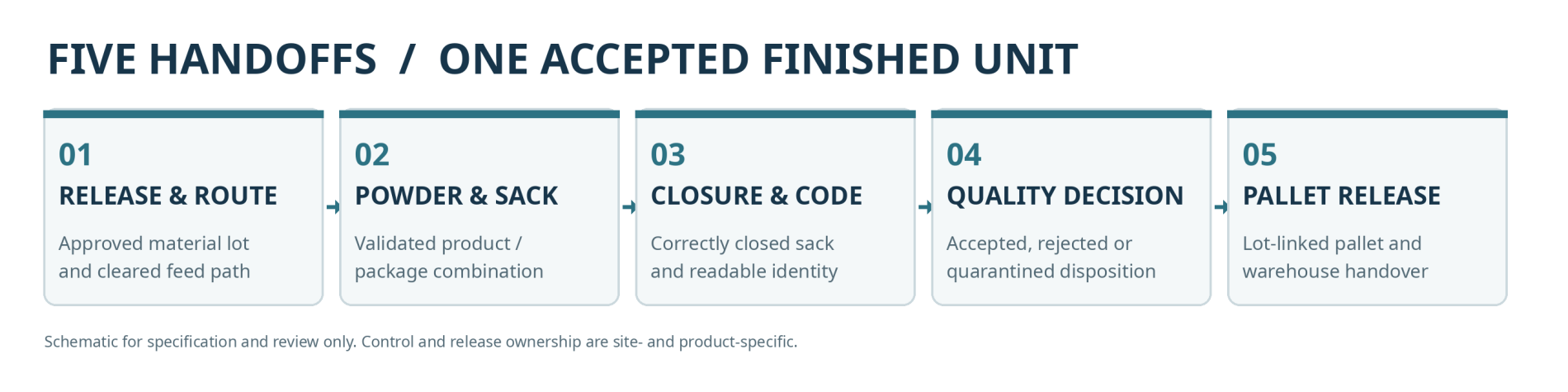
Feature article - From blend release to sealed sack: Five critical handoffs
Submitted by:
Andrew Warmington
Ma Junxin of Zhengzhou Wisdom outlines five controls for keeping powder identity, package acceptance and warehouse handover aligned
An approved batch of speciality-chemical powder is not yet a releasable commercial sack. Between blend release and dispatch, several teams must match material identity, the empty package, closing conditions, quality disposition and pallet records. Each piece of equipment can complete its own cycle while the finished unit remains unresolved.
The useful specification is therefore not only a list of machines or a peak filling rate. It is a documented handoff: what arrives, what confirms acceptance, how exceptions are held and who authorises the next step. The following five checks are a planning framework, not a substitute for product-specific hazard assessment or regulatory advice.
1. Released batch to the feed route
Before feeding starts, reconcile the released product code, batch or lot and work order with the selected hopper, conveying route and packaging campaign. The receiving team should also know what remains from the previous run, and which cleaning or line-clearance evidence the site requires. A system transaction alone does not establish that the transfer path is ready.
Where several substances share a line, the work order should point to the applicable safety information and agreed cleaning method. Equipment selection alone cannot decide which exposure, contamination or fire controls are appropriate without material-specific evidence and a competent site assessment. The material hazard assessment must guide exposure controls before operation.
For example, UK Health & Safety Executive guidance discusses enclosure, closed transfer and appropriately designed local exhaust ventilation where needed to reduce harmful exposure.1 Its guidance is a UK example, not a blanket specification for every powder or country.
2. Powder behaviour to an approved sack
Powders differ in bulk density, aeration, cohesion, dust generation and response to moisture. Empty sacks differ in mouth geometry, liner arrangement, seams and closing method. A useful trial therefore specifies the actual material condition and approved bag construction, as well as how the unit will be presented, filled and discharged.
A quoted ability to fill a nominal 25 kg bag does not establish compatibility with every powder or sack. Define which product–bag combinations were tested, the conditions represented and which combinations still require validation.
The trial record should identify the sampling method, observed presentation or spout problems, closure requirements and any agreed decision to repeat testing when the input changes. That evidence should be retained when bags, products or suppliers change.
3. Filled sack to closed, identified unit
A completed fill is not a completed commercial package. Specify the intended closure, any applicable net-content check, the approved label version and where variable product or lot information is verified. A miscode or an incomplete closure needs a defined hold or reject route rather than an unqualified addition to the good-output count.
Labelling obligations depend on the substance, the market and the transaction. For example, US OSHA Hazard Communication rules address shipped-container labels for hazardous chemicals2, while the EU Classification, Labelling & Packaging (CLP) framework has its own requirements for hazardous substances and mixtures placed on the EU market.3 Neither framework should be applied indiscriminately to every product or destination.
4. Closed sack to accepted output
Count filler cycles, closed sacks, held material, rejected sacks and accepted units separately. A failed check may occur after the scale has discharged the bag. Define who records the decision, how the physical bag is segregated and who can authorise rework or release. These details should reconcile with production reports and warehouse records.
At a changeover, identify the last accepted unit of the outgoing batch and the first accepted unit of the incoming batch. Check residual product, empty-bag stock, pre-printed labels and unfinished bags on conveyors. Record the remaining work in progress and the disposition of any pack with uncertain identity before returning to normal output. A counter reset does not itself clear material or resolve its identity.
5. Accepted sack to traceable pallet
Palletising creates a further handoff. A correctly stacked bag is not necessarily part of a released load. Define when the pallet count, product lot, label and quality status are complete, who creates the pallet identifier and who accepts the load into warehouse control.
Include a realistic downstream interruption in site acceptance testing: for example, an unavailable pallet position or blocked collection point. Record where completed sacks wait, how the line stops, what remains unconfirmed and who approves restart. The test measures the integrated handoff, not just machine cycles.
What the responsibility matrix should record
For buyers, a line quotation should identify each supplier's physical and control boundaries: feed, bag presentation, closing, inspection, reject routing and warehouse transfer. A short responsibility matrix makes omissions visible before installation. It also defines what must be demonstrated during commissioning and where the declared production rate is measured.
The objective is not to invent a universal packaging recipe. It is to make the conditions for an acceptable, traceable finished unit explicit before equipment is purchased, commissioned or changed. When bids quote different throughput numbers, this common definition also prevents a filler discharge rate from being mistaken for inspected, closed and warehouse-released output. The evidence can then be compared against one buyer-approved acceptance boundary.
Contact:
Ma Junxin
Zhengzhou Wisdom
https://zhengzhouwisdom.com/
References:
1. UK HSE, How to carry out a COSHH risk assessment: https://www.hse.gov.uk/coshh/basics/assessment.htm
2. US OSHA, 29 CFR 1910.1200(f): Labels on shipped containers: https://www.osha.gov/laws-regs/regulations/standardnumber/1910/1910.1200
3. ECHA CLP: Labelling & packaging: https://echa.europa.eu/web/guest/regulations/clp/labelling