
CDMOs grow in ADCs
Submitted by:
Andrew Warmington
Reflecting the ongoing boom in the development antibody-drug conjugates (ADCs), two Western CDMOs announced expansions in their capabilities in this field, while one more has reached a milestone in the European supply of a key ADC. A fourth has signed a licence agreement to expand its options in dual-payload ADCs.
Italy’s Olon expects to open a development centre combining ADC and mammalian cell development at Saint-Julien in France by the end of 2026. Further investments to expand ADC manufacturing capacity will follow in early 2027.
The company said that Saint-Julien is also “strengthening its links” with the site in Rodano, Italy, where it develops the highly potent APIs (HPAPIs) and payloads that go into ADCs. By doing this, said Maurizio Sartorato, VP of biotech, “we can offer greater continuity from development into manufacturing.”
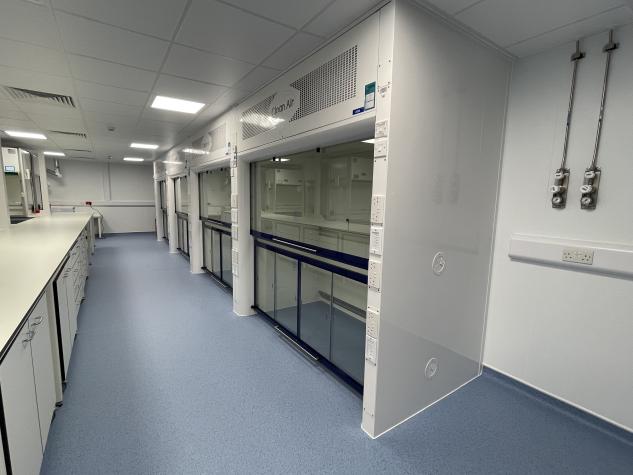
Meanwhile, Sterling Pharma Solutions has completed a large-scale GMP manufacturing suite at its dedicated bioconjugation facility in Deeside, UK, which will double capacity. The suite (pictured) includes a 500L reactor and a 130 m2 Grade C cleanroom. It will use both flexible and hard containment technologies to handle highly potent compounds.
Sterling has also added a new, 315 m2 analytical development laboratory at the site. As well as further HLPC capacity, it has an UPLC-LC/MS, a Bio-Techne MFI for particle size imaging, a protein stability characterisation instrument, an automated, plate-based ultrafiltration and diafiltration instrument, and a dedicated area for cell assay method development and analysis.
Axplora has completed the first R&D batches of Axotecan, its project to establish an independent European source of Exatecan for ADC developers. This is connected directly to downstream payload-linker and ADC manufacturing at the sites in Le Mans, France, and Gropello Cairoli, Italy.
Validation batches are targeted before the end of 2026, with registration activities in 2027 and initial GMP supply in late 2027. Exatecan is a highly potent topoisomerase I inhibitor and an important starting point for a growing class of ADC payloads. Access to material at the required quality, scale and time has become challenging due to high demand.
Finally, Lonza has acquired an exclusive licence agreement for the use of Qurient’s cyclin-dependent kinase 7 (CDK7) inhibitors for dual-payload ADC applications. Via this, the company will gain access to SYN-duo CC, a new dual-payload that combines a topoisomerase 1 inhibitor, a camptothecin derivative and a specific CDK7 inhibitor.
Lonza stated that this said will offer ADC developers an additional option for designing dual-payload ADCs where the CDK7 inhibitor potentiates the activity of the topoisomerase 1 inhibitor within a single targeted therapeutic approach. It will also be able to use its existing proprietary platform to derive additional, novel combinations of Qurient’s CDK7 inhibitor with any other payload.